Building Trust Into
Every Digital
Action
Digital Trust Foundry eliminates execution-time impersonation by delivering verifiable trust across systems, partners, and workflows. This is not another security tool — it is enterprise trust infrastructure.
Trust is the weakest link in digital ecosystems.

Enterprises secure networks, devices, and access — but still cannot prove authentication at the moment of execution.
As AI, automation, and cross-organizational workflows expand, digital interactions increasingly rely on assumed trust:
Systems act without proving who is behind the action
Vendors, devices, and APIs impersonate each other
Certificates, tokens, and passwords are stolen or misconfigured
Attackers pose as “trusted” internal systems
No authoritative, enterprise-wide source of truth exists for identity or authority.
Breaches succeed because organizations cannot prove the authenticity of an actor, its authority, or the artifact being acted upon at the moment something executes.
DTF exists to close this execution-time trust gap.

THE PROBLEM
Execution Time
Impersonation
The single biggest cybersecurity risk is identity impersonation at the moment of action. Most breaches begin with someone or something pretending to be legitimate.
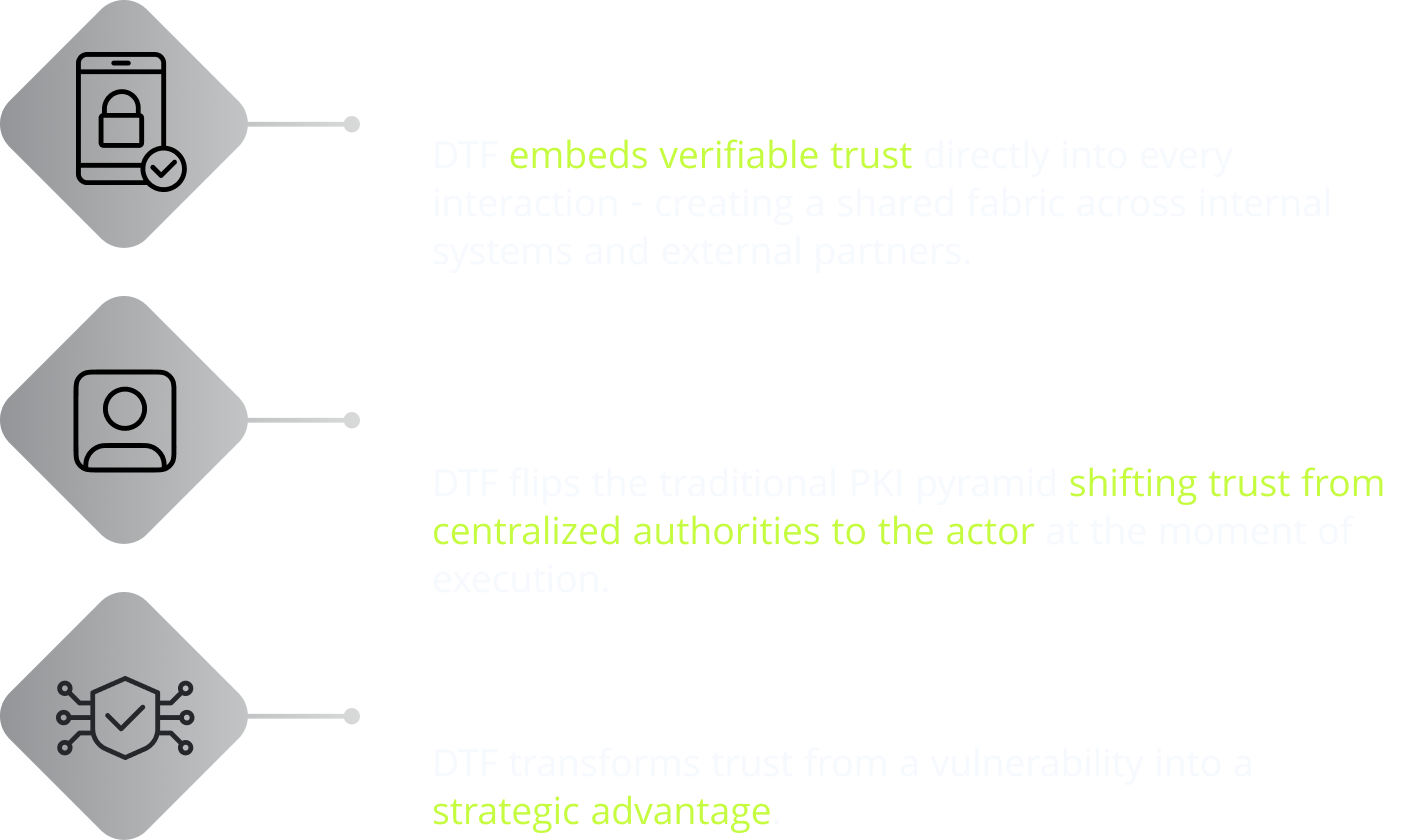
Replace Assumed Trust With Cryptographic Proof
Digital Trust Foundry provides the trust layer modern enterprises are missing — one that makes every digital interaction authentic, authorized, and tamper-evident.
Identity becomes a cryptographically enforced execution-time guarantee, not a static credential.
Why now?
Enterprises can no longer rely on assumed trust, static credentials, or network-based controls. They need cryptographic proof of identity, authority, and artifacts at the moment of execution.
That is why Digital Trust Foundry exists.
And that is why the time for execution-time trust is now.
-
AI agents, automation, and cross-organizational workflows now drive core operations — yet identity systems still rely on credentials designed for human logins, not autonomous execution.
The result is a widening trust gap at the exact moment digital activity accelerates.
-
Traditional identity stacks cannot authenticate autonomous systems, verify authority at execution time, or prevent machine-to-machine impersonation.
The number of non-human actors is exploding, and the trust infrastructure to govern them does not exist.
-
Modern enterprises operate across vendors, cloud providers, supply chains, regulators, and distributed teams — but trust does not travel across these boundaries.
-
Attackers no longer break in — they log in. They impersonate internal services, vendor accounts, APIs, devices, and automated workflows.
-
Governments and regulators are shifting toward cryptographic verification, demanding:
verifiable organizational identity
tamper-evident records
non-repudiable audit trails
cross-boundary trust frameworks
DTF aligns with this future — and helps enterprises get ahead of it.
HOW IT WORKS
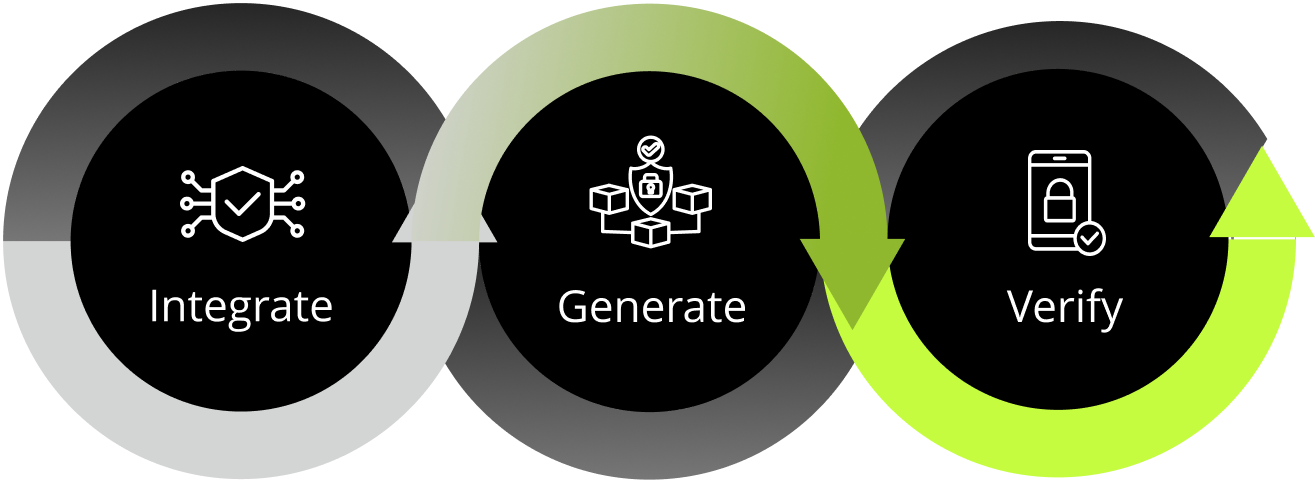
Deploy Trust
Infrastructure Your Way
DTF meets enterprises where they are — technically, operationally,
and compliance-wise in three ways: SaaS, Dedicated Cloud and On Premise.

Turn Trust into a Built-In
Digital Capability
Digital Trust Foundry enables organizations to make trust a foundational part of their digital operations — not an afterthought bolted onto systems, workflows, or compliance programs.
By unifying identity, authority, and artifact integrity into a single execution-time trust layer, Digital Trust Foundry gives enterprises a consistent, verifiable foundation that strengthens assurance while simplifying operations.
-
With cryptographic proof of who acted, what authority they had, and what artifact they touched, organizations eliminate the most common breach vector: actors pretending to be legitimate.
Digital Trust Foundry makes every digital action verifiable, tamper-evident, and auditable by default.
-
When trust is portable and independently verifiable:
New products can launch faster
Automated workflows become safer
Machine-to-machine interactions become trustworthy
Cross-organizational integrations no longer require custom trust logic
Teams innovate without rebuilding trust mechanisms for every system or partner.
-
DTF provides:
Non-repudiable audit trails
Cryptographically sealed records
Verifiable organizational identity
Execution-time authority enforcement
Compliance shifts from manual evidence gathering to automated verification.
-
Because DTF’s trust model is portable and cloud-agnostic, organizations can expand across:
new business units
new partners
new geographies
new digital experiences
—all without re-architecting trust.
DTF becomes the trust foundation that grows with the enterprise.
A New Standard for Seamless Digital Trust.
Automation, AI, and cross-organizational workflows now drive core operations, yet enterprises still rely on trust models built for a different era. Digital Trust Foundry closes the gap between what organizations must verify and what their infrastructure can actually prove.
By delivering cryptographic proof of identity, authority, and artifact at the moment of execution, DTF provides a trust foundation that is verifiable, portable, and built for modern digital ecosystems.
Trust You Can Build On

Trust becomes built-in, not bolted on
Every action becomes provable, not assumed
Every workflow becomes auditable, not opaque
Every integration becomes verifiable, not fragile
Every actor becomes accountable, not implied
This is the foundation for secure automation, resilient supply chains, trustworthy AI, and compliant digital operations.
The Future Belongs to Organizations That Can Prove Legitimacy.
Foundry Blog


Ask AI About Digital Trust Foundry
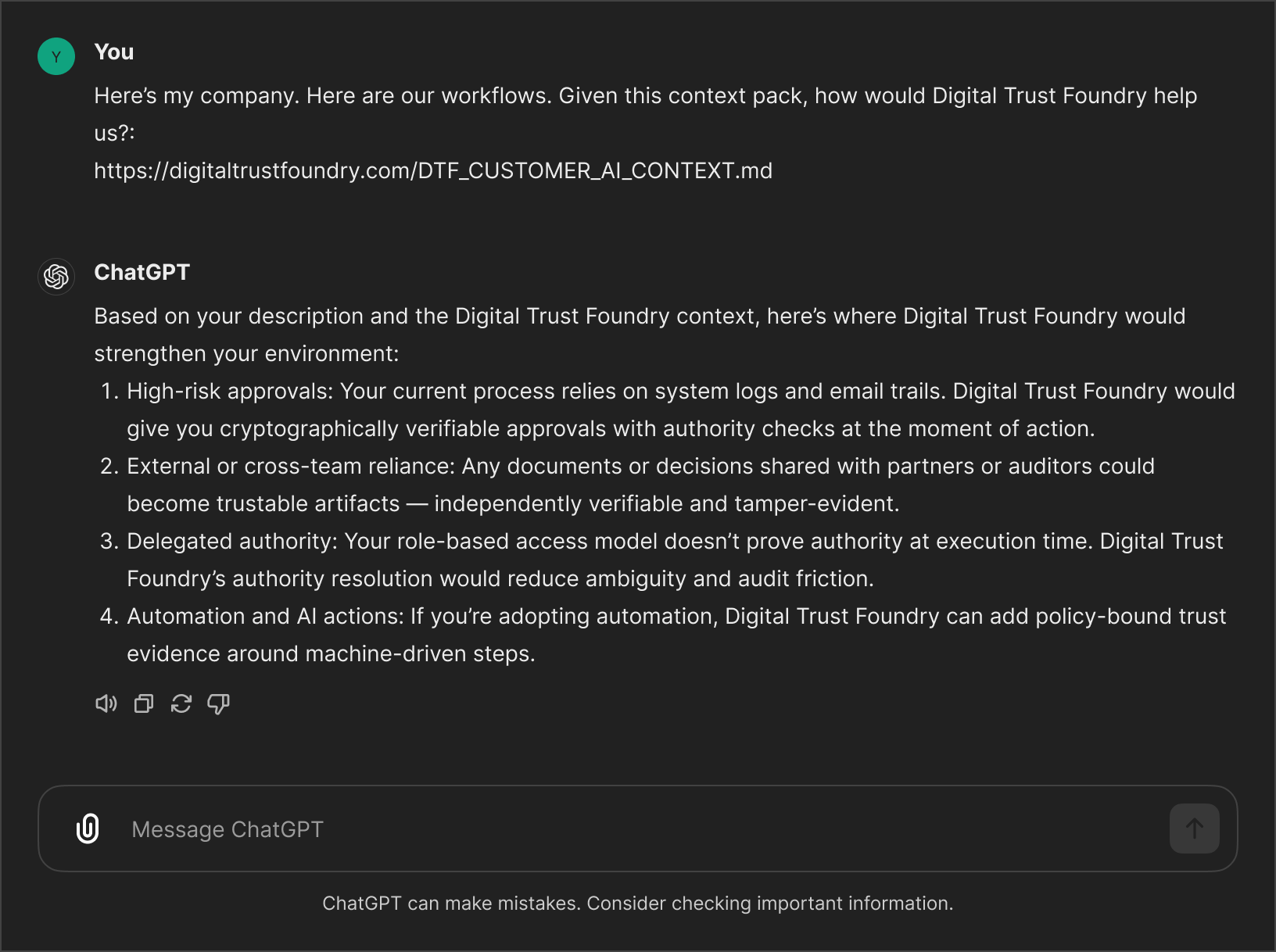
Paste our Customer AI Context Pack into your AI assistant and ask:
“Given our workflows, where does Digital Trust Foundry create the most value?”
Your AI will map your workflows to our capabilities: authority checks, lifecycle integrity, trustables, and verifiable approvals.